AI/UX
The AI Experience Framework for Financial Creators
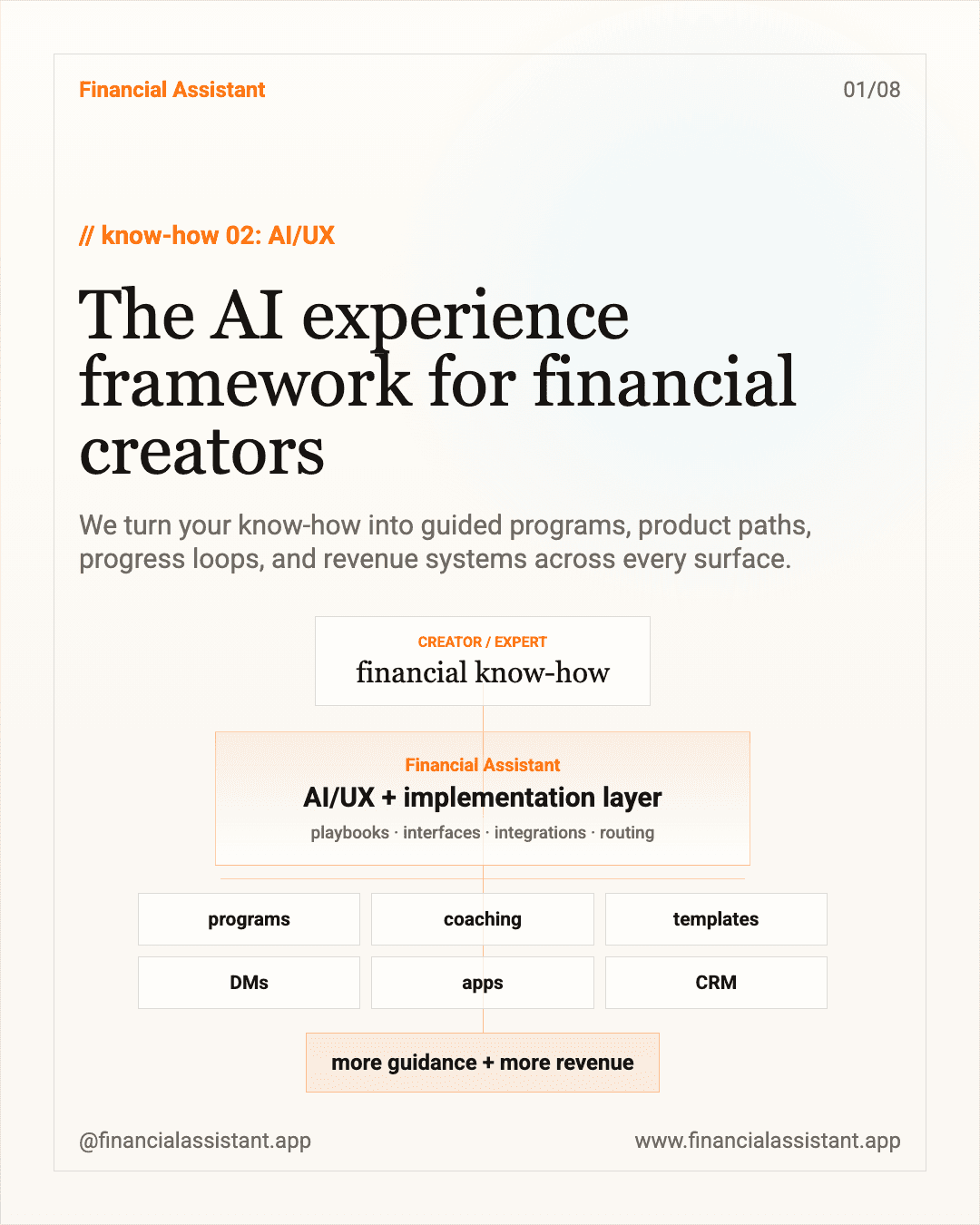
How Financial Assistant turns creator know-how into guided programs, product paths, progress loops, and revenue systems across every surface.
Search intent this guide answers
how to turn financial knowledge into an AI experience
Direct Answer
Financial creators can turn their know-how into an AI experience by converting their frameworks, templates, coaching methods, and product paths into a guided system. The system does not just answer questions. It helps a user understand the concept, apply the creator's method, review progress, decide what to do next, and move into the right product, program, workflow, or human handoff.
This is what we call AI/UX: the user experience layer around AI. It is the design of how a person moves from curiosity to action across ChatGPT, Claude, Instagram DMs, Meta surfaces, website chat, spreadsheets, course platforms, custom apps, CRMs, and other business systems. Financial Assistant designs and builds this layer for financial creators and their growth operators. This is not another build-it-yourself automation guide.
Why AI/UX Matters Now
Most creator businesses already have the raw material for AI products. They have frameworks, lessons, templates, calculators, rules of thumb, onboarding flows, coaching prompts, audience questions, and product paths. The missing layer is the experience that helps a person use that knowledge in context.
A financial creator's audience does not only want more information. They want help deciding what applies to them, what to do first, whether they are on track, and which offer is worth paying for. AI makes that guidance possible at scale, but only if the creator's method is structured into a real experience.
AI Chat Answers Questions. AI Experiences Guide Outcomes.
A generic AI chat can explain a topic. A creator AI experience should do more. It should carry the creator's point of view, ask for the right context, guide the user through the next action, and connect that action to the rest of the business.
For a financial creator, that could mean turning a budget template into a guided budget review, a course into an adaptive program, a lead magnet into a product recommendation path, or a coaching framework into a progress-check experience.
What AI/UX Includes
AI/UX is not only the prompt. It is the full operating layer around the user's journey:
- the creator's philosophy and teaching method
- the questions the system asks before giving guidance
- the interface or surface where the user interacts
- the data the user provides, such as goals, progress, worksheets, or metrics
- the feedback loop that tells the user how to improve
- the product, program, or offer map behind the experience
- the CRM, spreadsheet, app, or course platform that stores the next step
- the rules for when the AI should escalate to a person
The Experience Should Be Portable
Your method should work wherever your audience shows up. A user might begin in ChatGPT, ask a question through your Instagram DMs, use a calculator on your website, follow a program inside a course platform, update a Google Sheet, or move into a CRM workflow after becoming a qualified lead.
The channel can change. The experience logic should not. A portable AI experience gives the creator one consistent method that can be expressed across many surfaces instead of a separate disconnected automation in each tool.
Example: From Budget Template to AI Program
A financial creator may already sell or give away a budgeting spreadsheet. The old product is the template. The AI experience is the guided program around the template.
- The user asks for help with budgeting in a DM, website chat, or ChatGPT-style interface.
- The AI asks what the user is trying to fix and what numbers they already have.
- The system explains the creator's method for organizing spending, cash flow, and priorities.
- The user updates the sheet or app with their information.
- The AI reviews progress, identifies gaps, and recommends the next step.
- The system routes the person to a free resource, paid template bundle, course, coaching path, or human review.
The creator has not been replaced. Their method has become easier to use, easier to distribute, and easier to monetize.
How Financial Creators Can Design an AI Experience
1. Choose one repeatable user journey
Pick a journey that already happens often: choosing a template, applying a framework, reviewing progress, qualifying for a program, preparing for a consultation, or deciding which product fits.
2. Map the creator method
Write down the creator's point of view, questions, examples, boundaries, steps, common mistakes, and decision rules. This is the knowledge layer that keeps the AI from sounding generic.
3. Design the user experience
Decide what the user sees, what they provide, what the AI explains, what the system reviews, and what progress looks like. This is where AI/UX becomes a product instead of a chat window.
4. Connect the business systems
Connect the experience to the right surfaces: Instagram DMs, Meta Business AI, website chat, ChatGPT, Claude, Google Sheets, Kajabi, a custom app, CRM, email, checkout, calendar, support, or collaboration review.
5. Route outcomes
Define what happens when the user is ready for a product, needs more education, should be nurtured, qualifies for a call, needs support, or should be escalated to a person.
Where Financial Assistant Fits
Financial Assistant is the implementation and systems layer for financial creators and growth operators. We help turn financial know-how into AI experiences that can live across chat, social, apps, spreadsheets, CRMs, and product workflows.
We help map the playbook, design the user journey, write the AI instructions, connect the systems, define the routing logic, and create the feedback loops that make the experience useful over time. The creator brings the expertise. We turn it into a guided, portable, revenue-generating experience.
FAQ
What is an AI experience for financial creators?
An AI experience is a guided program built around a creator’s financial knowledge. Instead of only answering questions, it helps an audience member learn, take action, review progress, and move to the right product, workflow, or human support path.
What does AI/UX mean?
AI/UX is the experience layer around AI. For creators, it means designing how the audience interacts with the creator’s knowledge across chat, DMs, apps, spreadsheets, courses, CRMs, and websites so the AI can guide people toward outcomes.
How is an AI experience different from a chatbot?
A chatbot usually answers messages. An AI experience has a fuller structure: it understands the person, teaches the creator’s method, reviews progress, adapts the next step, and routes the person to the right offer, program, tool, or workflow.
Where can a creator’s AI experience live?
A creator’s AI experience can live across ChatGPT, Claude, Instagram DMs, Meta Business AI, a website chat agent, a Google Sheets add-on, a course platform, a custom app, a CRM workflow, or an email/community surface.
How can financial creators use AI to create new revenue streams?
Financial creators can use AI to turn their frameworks, templates, courses, and coaching methods into guided products. The AI can onboard users, answer questions, review inputs, recommend improvements, and route people into paid programs or higher-touch offers.
Do creators have to build this themselves?
No. Financial Assistant is the implementation and systems layer for creators and growth operators. We help design the playbook, build the AI experience, connect the surfaces, and integrate the experience with products, CRMs, apps, and workflows.
What should a creator automate first with AI/UX?
Start with one repeatable journey where people already ask for help: using a budgeting template, choosing the right course, reviewing progress, qualifying for coaching, preparing for a consultation, or deciding which offer fits their situation.
Why does portability matter for AI experiences?
Portability matters because the audience does not stay in one channel. The same creator method should work in a DM, a chat, a spreadsheet, a course, a website, or an app, with consistent logic and routing behind it.