How to Build Your Own Financial Planning System with AI and Google Sheets™
Use your financial picture to set meaningful goals, build a budget, put savings to work, and keep improving your plan with your AI.

A financial planning system connects your complete financial picture with your goals, decisions, and regular reviews. Once Financial Management has organized your income, expenses, liabilities, and assets, use your Financial Plan from Financial Assistant with your AI to decide what your money should accomplish and keep making progress.
The Personal Finance Playbook connects Financial Management with Financial Planning in a matching Google Sheets™ workspace. Each prompt below asks your AI to use your Financial Plan from Financial Assistant, build on your existing numbers and decisions, and propose the next useful change.
These prompts assume your AI is connected to Financial Assistant and can read your Financial Plan and its underlying income, expense, and account information. They also draw on relevant preferences already available to your AI, such as the spending you value, the flexibility you want, and the retirement life you imagine. If a preference is unavailable or may have changed, your AI should ask before using it. You review proposed changes before they are saved to your Sheet.
Before planning: start with your complete financial picture
Bring together two views: cash flow shows what you can direct toward progress each month; net worth shows your current financial position. A large account balance does not tell you whether a new monthly payment fits, and a good monthly income does not tell you how much debt you have.
Financial Management assembles this picture. If yours is incomplete, use the Personal Financial Management guide first. The planning prompts assume those figures are available and ask about missing or changed details as needed. If your picture is ready, start with your goals.
Worked example · Alex is fictional. The budget, account balances, and worksheet images below follow the current Personal Finances demonstration. Proposed changes and retirement scenarios are identified separately.
How much do you have left after income and expenses?
Your completed cash-flow view includes income after taxes and existing payroll deductions, the cash cost of living, required debt payments, and provision for irregular bills. Transfers and repayments need to be reconciled so the same money is counted once. Carry that available-cash figure into planning.
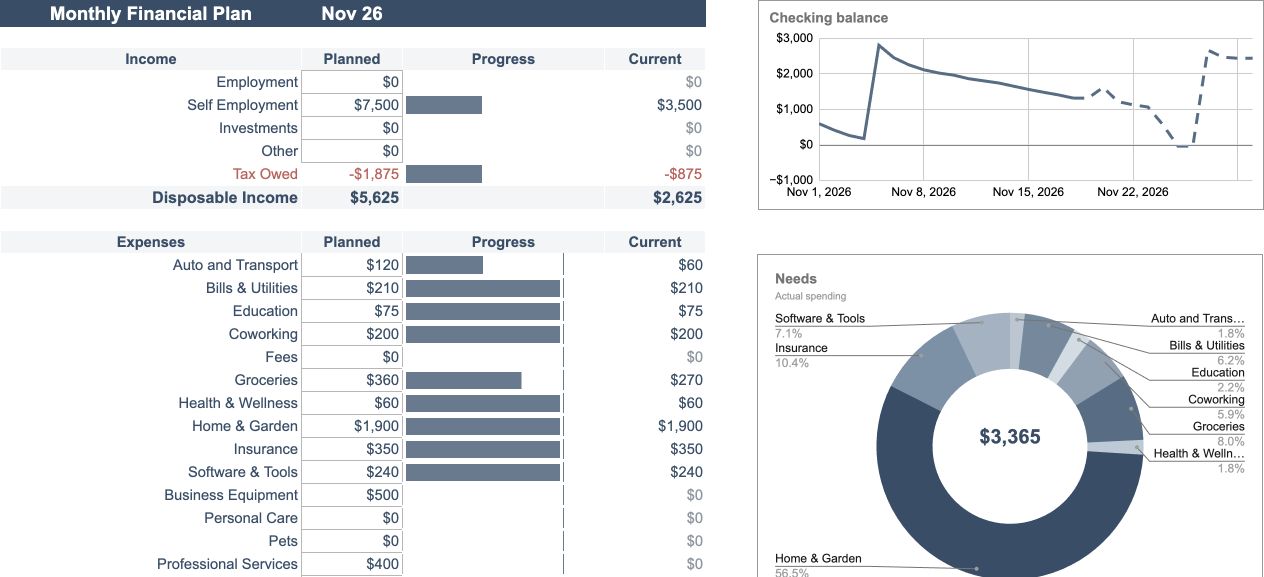
| Monthly cash flow | Amount |
|---|---|
| Income | $7,500 |
| Tax allowance | −$1,875 |
| Available after tax allowance | $5,625 |
| Needs | −$4,415 |
| Wants | −$610 |
| Remaining for additional priorities | $600 |
The 25% tax allowance is an assumption for this demonstration. Your effective tax rate depends on your income sources and circumstances. Before using the $600, confirm all required payments and irregular commitments are covered; add any that are missing. If cash flow is negative, address that shortfall before assigning money to new goals.
What is your net worth?
Net worth = assets − liabilities. Record balances on a consistent date, including cash, investments, retirement, property, and debts. Also identify which assets are accessible: home equity and retirement savings do not serve the same purpose as cash for next month’s bills.
| Assets and liabilities | Balance |
|---|---|
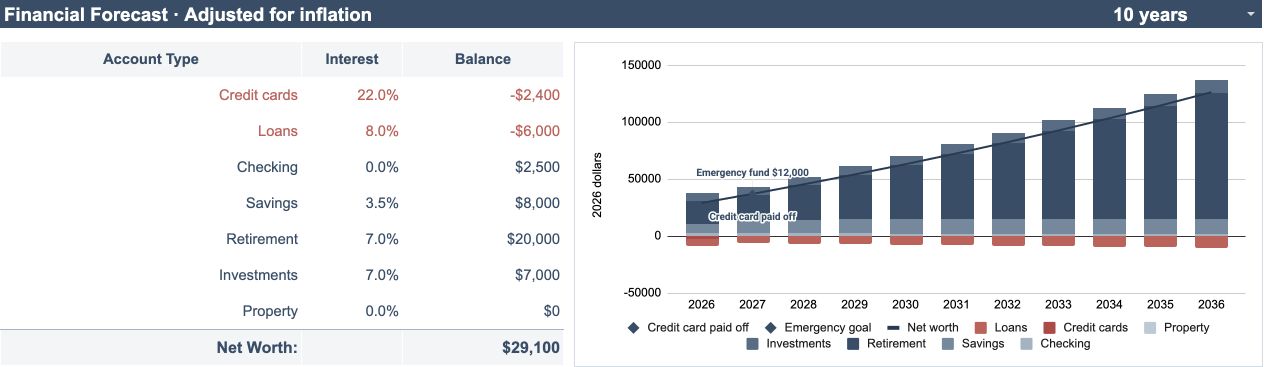
| Checking + savings ($2,500 + $8,000) | $10,500 |
| Retirement + investments ($20,000 + $7,000) | $27,000 |
| Total assets | $37,500 |
| Credit card + loan ($2,400 + $6,000) | −$8,400 |
| Net worth | $29,100 |
Putting $600 into savings or toward debt principal can both improve net worth. Paying interest is a cost; paying principal reduces a liability. Moving money between your own accounts changes its location, while market prices can change net worth without changing this month’s cash flow.
Before a home purchase, a car purchase, or a debt payoff plan, return to these two views. Check both the ongoing payment and what the upfront cost would do to your reserves and net worth.
1. What do you want your money to make possible?
Your financial picture shows what is possible today. Your goals give those numbers a purpose: security, a home, a car, education, travel, time away from work, or retirement. Build on priorities you have already shared with your AI, then explore what you would regret delaying, which dates matter, and whether reaching one goal would make another easier.
Give each goal an amount, starting balance, deadline, priority, and destination account. For a savings goal, a starting calculation is (target − money already assigned) ÷ months remaining, excluding interest. Debt goals also need interest and payment terms included.
Alex’s worksheet includes a credit-card payoff and a $12,000 emergency-fund milestone. If all $8,000 of savings is available for emergencies, the gap is $4,000. At $600 per month, that requires seven contributions, with a smaller final contribution, excluding interest. If some savings is earmarked for taxes or other bills, the gap is larger.
At the demonstration’s $4,415 monthly Needs baseline, $12,000 covers about 2.7 months. A six-month target would be $26,490. Choose a reserve based on income stability, dependents, insurance, and essential commitments; six months is a scenario to evaluate. CFPB’s emergency-fund guide
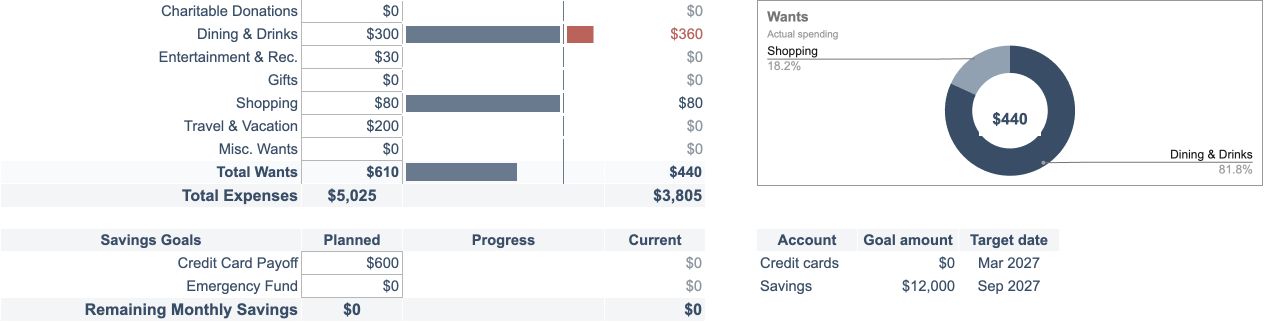
A $600 monthly surplus cannot simultaneously fund every goal at $600. If the card comes first, the emergency-fund date needs to reflect when contributions can start. If both need funding now, compare a split and the effect on each date.
Once you choose a goal, compare the contribution it needs with the cash already available. If the goal is funded, choose where the remaining money goes. If there is a gap, explore spending changes, income opportunities, account earnings, or a different target date. For a retirement goal, use the retirement scenario. Let the result guide the next question.
AI prompt to turn your financial picture into meaningful goals
“Use my Financial Plan from Financial Assistant, including my income, expenses, liabilities, assets, and cash available for goals. Build on what I’ve shared about what matters to me and the life I want. Suggest goals that fit those priorities, including options I may have overlooked. Ask about preferences that are missing or may have changed. Explore what I would regret postponing and which goal could make others easier. Show the funding trade-offs, help me choose a first goal, and propose its amount, date, account, and contribution.”
2. How do you build a budget that gets you closer to that goal?
Work backward from the goal you chose and the income and expenses already in your Sheet. Compare the required contribution with your current surplus. Then look for the smallest changes that could close the gap or move the goal forward while keeping the spending you value.
Separate one-off purchases from recurring habits and annual bills. Check paydays and due dates as well as monthly totals: a month that balances overall can still leave checking short before the next payment arrives. Financial well-being includes both resilience and the freedom to enjoy life. CFPB’s financial well-being findings
What would a change you can live with make possible?
Suppose Alex chooses the credit-card payoff as the next goal. Looking for changes that could bring it forward, Alex decides dining can fall from $300 to $250 and shopping from $80 to $55 without giving up what matters most. Those choices come from discussing value and actual use.
| Monthly plan | Starting | Proposed |
|---|---|---|
| Needs | $4,415 | $4,415 |
| Wants | $610 | $535 |
| Total expenses | $5,025 | $4,950 |
| Available for goals | $600 | $675 |
That frees $75 per month, or $900 over a full year if sustained. The allocation step below tests what directing that $75 to the chosen card goal changes. If the goal still cannot be funded, compare income opportunities or a more flexible date before choosing further cuts.
AI prompt to find spending changes that move your goal forward
“Use my Financial Plan from Financial Assistant and the goal we chose. Work backward from its date to find the monthly funding needed. Use what I’ve told you I value to identify spending changes I would barely miss, while protecting what adds the most to my life. Ask about use or enjoyment where it is unclear. Compare the smallest workable change with a larger change I might prefer, showing the effect on the goal date, funding gap, and daily life. Keep bills and reserves covered and propose budget updates for approval.”
3. Where should you put savings to make the most progress?
Cover essential commitments and required payments first. Then weigh emergency liquidity, high-interest debt, any employer match, and your goal deadlines. The SEC’s investor checklist highlights goals, expensive debt, employer matching, risk tolerance, fees, and diversification as important checks.
- High-interest debt: list balances, APRs, minimum payments, and promotional or prepayment terms. Extra payments toward the most expensive balance can reduce interest while you maintain required payments on the others. Investor.gov’s debt-payoff guidance
- Emergency cash: protect enough accessible money that an unexpected bill does not immediately force new borrowing. A larger reserve and faster debt repayment compete for the same cash.
- Employer retirement contributions: if available, check the match formula, eligibility, and vesting before deciding the order. Contributions already deducted from pay must not be counted again. IRS matching-contribution guidance
- Other debt and investments: compare borrowing costs with uncertain investment returns, after considering fees, tax treatment, access, and time horizon. Choose an investment mix suited to the goal and diversify; the highest advertised return does not establish the best fit. Investor.gov’s allocation guide
How does an extra $75 change a debt goal?
Alex’s demonstrated card balance is $2,400 at 22% APR. If $600 is the total monthly card payment, payoff takes about five payments; at $675, about four. This calculation uses APR ÷ 12, interest added before each payment, and no new purchases or fees. Actual statements and payment dates can change the result.
Working backward from a four-payment target reveals another option: about $628 per month would meet it under the same assumptions, only $28 above the starting payment. The $675 option pays down the balance faster within that period and reduces interest further. Alex can compare a smaller lifestyle change with a larger payment, instead of assuming every proposed cut is necessary to reach the date.
Before adopting a payment, confirm the cash cushion, any available match, and whether the $600 in the worksheet is the total payment or an extra payment. Add required payments to the model when it is extra.
Record the contribution, account, target balance, and date you choose. If changing one priority delays another, make that visible before saving the plan.
AI prompt to compare where your next dollar changes the goal most
“Use my Financial Plan from Financial Assistant, including my account balances, liabilities, chosen goals, and agreed budget. Compare where each available dollar could have the greatest effect, taking into account the flexibility and comfort with risk I’ve described. Check borrowing costs, protected cash, employer matching, and deadlines; ask for missing terms or preferences that could change the choice. Show each allocation’s effect on interest, goal dates, and cash access. Distinguish avoided debt costs from uncertain investment returns. Propose amounts and destination accounts without allocating the same money twice.”
4. How can your financial picture become a retirement plan?
Use the retirement goal identified earlier and the income, expenses, and assets already in your Sheet. Ask which current costs will end, continue, or grow in retirement. Add the missing healthcare, tax, and income-timing details. The portfolio must cover the remaining gap, including any years before pensions or Social Security begin.
Starting portfolio target = annual amount investments must fund ÷ withdrawal-rate assumption. When the portfolio funds all spending, a 5% assumption means monthly retirement expenses × 12 ÷ 0.05, or 20 times annual spending. The withdrawal assumption is separate from the investment-return assumption.
| Calculation | Target |
|---|---|
| $4,000 × 12 | $48,000 a year |
| $48,000 ÷ 5% | $960,000 |
| $48,000 ÷ 4% | $1,200,000 |
| Difference between assumptions | $240,000 |
The 5% rate is an adjustable planning assumption, not a guarantee that withdrawals will last. Test a longer retirement, inflation, lower returns, poor early market returns, and spending flexibility. Morningstar’s research explains why retirement length changes withdrawal planning.
Compare the target with invested assets, contributions, employer benefits, and the time available. Alex has $27,000 in retirement and investments in the starting snapshot; the whole $29,100 net worth is not an interchangeable retirement portfolio. Account access, taxes, and the timing of other income matter. Use today’s dollars consistently or inflate future expenses and the forecast consistently.
AI prompt to turn your current finances into a retirement scenario
“Use my Financial Plan from Financial Assistant and the retirement life I’ve described. Start with my current spending, assets, liabilities, and agreed contributions. Use my stated preferences to explore which costs would end, continue, or increase, asking about details still unclear. Include healthcare, taxes, and reliable income with its start date. Compare 5% and 4% withdrawal assumptions separately from investment returns. Show how changing contributions, spending, or the retirement date affects the lifestyle I want. Test a longer retirement and poor early returns, then propose forecast changes for review.”
5. Could better account earnings help you reach a goal?
Review both what your money is for and where it is held. Separate taxes, upcoming bills, emergency reserves, and near-term goals before deciding whether cash is unassigned. Emergency savings can itself earn interest in an appropriate accessible account.
Alex’s $10,500 in checking and savings is not automatically available to invest: checking may cover upcoming bills, and savings may hold the emergency cushion. Cash above six months of expenses may still have a purpose when taxes, purchases, or unstable earnings require it.
Compare cash accounts using current APY, fees, minimums, access, promotional terms, and applicable insurance. Verify the bank and coverage. FDIC deposit-insurance guidance
Could the same goal need a smaller monthly contribution?
For a later savings stage, suppose Alex has finished the card goal, has $8,000 assigned to an emergency reserve, and wants that reserve to reach $12,000 in six months. Compare what the account rate changes before deciding whether more spending cuts are needed.
| Hypothetical account APY | Monthly contribution needed |
|---|---|
| 0.1% | $666 |
| 4.0% | $636 |
The higher assumed rate reduces the required contribution by about $30 per month for this goal and date. Alternatively, keeping contributions unchanged could help reach the goal sooner; calculate whether it changes the actual completion month. Rate improvements alone may not close a funding gap.
These are comparison assumptions, not current offers: $8,000 initially, six equal end-of-month contributions, constant APYs converted to monthly rates, no fees, and tax excluded. Contributions are rounded up to whole dollars. Preserve the safety and access the reserve needs. You can also explore contribution requirements with Investor.gov’s Savings Goal Calculator.
Also review recurring spending that no longer provides value, borrowing costs, income opportunities, employer benefits, investment fees, tax efficiency, and concentration risk. Rank improvements by their likely effect, effort, and trade-offs. A change should improve the plan and your life, rather than merely make a category smaller.
AI prompt to make your savings work harder for a chosen goal
“Use my Financial Plan from Financial Assistant and the account assigned to my savings goal. Check whether its cash could earn more while preserving the safety and access I need. Weigh the benefit against the account-management effort I’m willing to accept; ask if that preference is unknown. Compare verified APYs, fees, taxes, insurance, and terms. Recalculate the contribution needed for the same date and the completion date with unchanged contributions. Show the actual improvement, including when it does not change the month, and propose goal updates for approval.”
6. What could disrupt the goals you chose?
Cash flow, goals, debt, investments, and retirement work together with taxes and protection against setbacks. The CFP Board’s planning-process overview includes personal circumstances, insurance and risk, taxes, alternatives, implementation, and ongoing review.
- Taxes: check the full-year estimate, withholding or estimated payments, and how account choices affect after-tax cash. The IRS withholding estimator serves eligible wage and pension income; self-employed income may need a separate estimated-tax review.
- Insurance and income protection: review coverage, deductibles, dependents, and what a loss of income would do to the plan. Include premiums and uninsured costs in the budget and reserve discussion.
- Beneficiaries and estate arrangements: check that account designations and relevant documents still reflect your wishes. Record questions for the provider or appropriate professional.
- Resilience: test a lower-income month, a major bill, and a goal that costs more than expected. Check that the plan still covers essential commitments.
Use the Sheet to keep the financial effects and outstanding questions visible. Coverage, tax treatment, estate documents, and investment suitability need verification with the appropriate provider or qualified professional.
AI prompt to find gaps that could disrupt your plan
“Use my Financial Plan from Financial Assistant, our chosen goals, and the household and work circumstances I’ve shared. Find which plausible disruption could most affect the commitments and people I want to protect. Stress-test a lower-income period or major bill against existing cash and commitments. Ask about relevant coverage or preferences that are missing rather than assuming them. Show which goal becomes vulnerable and what budget or reserve change could help. Identify questions to verify with the appropriate provider or professional and propose changes for approval.”
7. How do you keep your financial plan on track?
Return to the goals, contributions, and dates you approved. Compare actual results with that plan, identify why a difference occurred, and choose an adjustment proportionate to the cause. A late paycheck and a recurring overspend call for different responses.
- Weekly check-in: review cash, bills before payday, unusual transactions, and planned payments or transfers.
- Monthly review: compare actual income and spending with the budget; reconcile balances, net worth, and goal progress; revise contributions or dates where needed.
- Completed goal: choose the next destination for its monthly contribution. After debt payoff, check both the extra payment and any minimum payment that has ended.
- Life change: revisit assumptions after a new job, major purchase, new dependent, health change, or unexpected expense. Review investment mix and tax assumptions periodically.
When Alex’s card is repaid, the planned contribution becomes a new decision. It could help fund the emergency reserve or another goal. The playbook supports reviews you conduct; you approve Sheet changes and arrange account transfers.
AI prompt for a weekly check-in or monthly financial review
“Use my Financial Plan from Financial Assistant to compare current income, expenses, balances, and goal progress with the plan I approved. Ask for the prior plan if it is unavailable. Separate timing differences and one-off events from recurring funding gaps. Compare the smallest useful adjustment, using what I’ve shared about changes I can realistically sustain. If an approach repeatedly falls short, ask what makes it difficult and whether my priorities have changed. If a goal is complete, explore the next use of its contribution. Confirm updates before saving.”
How do Financial Assistant and your AI support this system?
Financial Planning is included in the Personal Finance Playbook, alongside Financial Management. The Financial Planning template provides the monthly plan, savings goals, and forecast. Finance OS brings transactions and balances from linked accounts into your Google Sheet.
With Financial Assistant connected to your AI, start by asking it to use your Financial Plan and the income, expense, and account information behind it. Begin with goals, then work through the relevant questions: find useful adjustments, compare allocations, test the result, and approve the changes you want to keep in your Sheet. Each answer becomes an input to the next decision.
The prompts throughout this guide show parts of that conversation. The full playbook connects the questioning process with the matching template. Together, your financial picture, chosen goals, budget, allocations, and reviews become a system you can understand, revise, and keep using.
Common questions about financial planning with AI
What should I know before making a financial plan?
Know your after-tax income, expenses, cash available for goals, and net worth. Identify debt terms, cash already reserved for commitments, and accessible assets. These establish the starting point for a purchase, debt plan, or retirement decision.
What is the difference between financial management and financial planning?
Financial Management establishes and maintains your financial picture. Financial Planning uses that picture to choose priorities, fund goals, explore retirement, and review progress. Both are included in the Personal Finance Playbook.
How can AI help me make a budget I will stick to?
Use the Financial Plan, chosen goal, and relevant preferences you have already shared with your AI. Ask it to find small spending changes you would barely miss, clarifying value or usage where needed. Compare how each change affects the goal while keeping bills and cash timing covered.
Where should I put my savings first?
Cover essential commitments and required payments, then compare expensive debt, emergency cash, and available employer matching. Remaining choices depend on goal deadlines, borrowing costs, tax treatment, investment risk, fees, and access.
Can AI tell me how much I need to retire?
Your AI can help organize inputs and calculate scenarios. Begin with retirement spending and the amount reliable income covers, then test the portfolio-funded gap under different withdrawal assumptions. Verify the inputs and test the forecast before relying on a target.
Does the 5% retirement formula guarantee my money will last?
No. It estimates a starting target under a chosen withdrawal assumption. Retirement length, market returns, inflation, taxes, fees, and spending flexibility affect sustainability.
Should I invest all cash above six months of expenses?
First account for bills, taxes, goals, and the reserve appropriate to your situation. Review only genuinely unassigned cash for another purpose. You can also review the interest earned on emergency savings while preserving appropriate safety and access.
Get the Personal Finance Playbook
Use the guided prompts with your AI and the matching Google Sheets template to get financial clarity, build a budget that fits your life, choose where savings go, and keep making progress.
Enter your name and Gmail address below and we’ll send you the playbook.