How to Manage Your Money with AI and Google Sheets™
Build your complete financial picture with connected AI prompts for income, taxes, spending, debt, cash, and net worth—then use it to make better money decisions.

Personal financial management is the ongoing process of understanding your income, spending, debt, cash, and assets so you can make informed money decisions. Bring three things together. Understand what you earn after taxes, where that money goes, and what you own and owe. That gives you the financial picture to answer questions such as “How much should I spend on rent?”, “Can I afford a car?”, and “Which debt should I pay down first?”
The Financial Management part of the Personal Finance Playbook helps you assemble that picture in Google Sheets™. You work through Income, Expenses, and Accounts with your AI, filling in missing details and checking the numbers before using them to make a plan.
These prompts use your Financial Plan from Financial Assistant and its underlying Income, Expenses, and Accounts. Connect your AI to the workspace before starting. Let it use relevant preferences you have already shared; when information is missing, uncertain, or out of date, it should ask. Check assumptions and approve proposed changes before they are saved to your Sheet.
What belongs in your complete financial picture?
Your financial picture connects your monthly cash flow with your account balances. A good review shows the income you can rely on, the commitments already attached to it, the cost of your debts, and the money available for your priorities.
| Worksheet | What to understand | What it helps you decide |
|---|---|---|
| Income | Sources, full-year forecast, tax assumptions, and after-tax cash | How much income can support your spending and goals |
| Expenses | Needs, Wants, recurring bills, and irregular costs | What to keep, change, or prepare for |
| Accounts | Debt, interest, payments, cash, investments, retirement, and property | How much flexibility and financial resilience you have |
Start with recent statements, pay stubs, tax records, and several months of transactions. Reviewing a full year helps surface annual bills and seasonal income. Use the same reporting dates across accounts so balances and comparisons line up.
1. How much do you earn, and how much will you keep?
List every source of income separately. Include wages, bonuses, commissions, freelance or business income, interest, dividends, rental income, and realized investment gains where applicable. Record how often each source pays and whether the amount is dependable, variable, or a one-time event.
A deposit may require another question. A transfer from savings moves existing money. A loan adds a liability. Selling an investment can return your original capital as well as create a gain or loss. Keeping those transactions identifiable makes your income forecast more useful.
For freelance work, track revenue and related business expenses so the forecast can distinguish receipts from net profit. When reviewing rental income or investments, preserve the information needed to determine the taxable portion. Ordinary dividends, qualified dividends, and capital gains can receive different federal tax treatment. IRS guidance on investment income
Build a full-year forecast from actuals and expectations
For each source, add income received so far to what you reasonably expect during the rest of the year. Use expected pay dates, signed work, or a conservative assumption for variable income. Revisit the forecast when the facts change.
The same fictional person appears throughout this guide. The income review happens halfway through the year. Amounts are illustrative, and the forecast assumes the remaining income arrives as expected.
| Income source | Received so far | Expected remainder | Full year |
|---|---|---|---|
| Gross wages | $48,000 | $48,000 | $96,000 |
| Freelance net profit | $4,500 | $7,500 | $12,000 |
| Bank interest | $300 | $300 | $600 |
| Total | $52,800 | $55,800 | $108,600 |
If the freelance work falls through, the income available for the budget changes. Your AI should ask what supports that forecast before using it to justify a larger fixed commitment.
AI prompt to find the income your budget can rely on
“Use my Financial Plan from Financial Assistant and the income records behind it. Separate recurring earnings, variable income, reimbursements, transfers, and borrowed money. Build a full-year forecast from actual income and supported expectations. Ask what supports uncertain receipts. Compare the expected case with a weaker-income case, showing the difference in monthly cash I can commit. Propose source labels, forecast amounts, and assumptions for my Income worksheet for me to approve.”
Estimate taxes using the right income and tax assumptions
For a U.S. household, a tax estimate needs more than the sum of its deposits. Filing status, income types, adjustments, deductions, credits, and applicable state or local rules can change the result. Self-employment can also create a separate self-employment tax obligation. Record the tax year and the assumptions used. IRS Tax Withholding Estimator guidance, IRS withholding and estimated tax guidance
An effective tax rate expresses tax as a percentage of a defined income amount. Label both sides of that calculation. For example, a federal income tax rate based on adjusted gross income answers a different question from a combined cash-planning rate that includes state and payroll taxes.
If you apply an estimated rate to taxable income in the Sheet, identify the taxable-income base and which tax that rate covers. Keep gross earnings, taxable income, tax liability, and take-home cash visible as separate amounts. You can also show the after-tax share as one minus the applicable estimated rate, using the same income base.
For the fictional example, assume a full-year combined tax estimate of $27,780 and no other income or payroll deductions. This is a cash-planning assumption covering the taxes included in the example. Replace it with an estimate appropriate to your own filing situation.
| Annual income check | Amount |
|---|---|
| Forecast income | $108,600 |
| Assumed combined taxes | $27,780 |
| After-tax income | $80,820 |
| Monthly after-tax average | $6,735 |
That is a combined planning rate of about 25.6% of this example’s forecast income. The dollar estimate gives an annual after-tax amount to work from. Check the actual timing of paychecks and freelance receipts before committing cash.
Next, compare the tax estimate with expected withholding and estimated payments. In this example, $24,000 of full-year withholding would leave $3,780 to cover through other payments. Spread across a full year, that is $315 per month. Recheck the remaining amount and payment timing during the year. IRS guidance on estimated tax payments
When the budget starts with take-home pay, account for taxes already withheld. Then reserve for any additional tax obligation on other income. That keeps the same tax from reducing available income twice.
AI prompt to check whether your tax reserve is enough
“Use my Financial Plan from Financial Assistant and the income forecast we established. Check whether each source is recorded before or after tax. Ask only for missing filing details, tax-year assumptions, deductions, and expected withholding or payments. Separate taxable income from cash received. Estimate any uncovered tax obligation and when it must be funded, showing how it changes spendable cash without subtracting withheld tax twice. Identify what needs verification with tax records or a tax professional, then propose updates to my tax assumptions and reserves for approval.”
2. Where does your money go, and what is worth keeping?
Start with actual spending. Group transactions consistently, then review the transactions behind each category. Separate Needs and Wants so you can see which costs support your daily life and which choices have more flexibility.
Needs commonly include housing, basic utilities, groceries, essential transport, and insurance. Wants might include dining out, entertainment, travel, and upgrades. Your circumstances determine the classification. Reliable transport for work may be essential, and a more expensive version of it may add a discretionary cost.
The first question is how much you spend. The next is whether that spending reflects what you value. Ask which purchases you enjoyed, which commitments you barely use, and which large costs limit choices you care about more.
- If a category increased, identify the charges responsible before setting a new limit.
- If a bill is annual, record its next due date and what you need to reserve.
- If a cost is genuinely one-time, show how it changes that month’s cash requirement.
- If a purchase and its credit card payment both appear, identify the transfer between accounts so the spending total counts the purchase once.
For the fictional person, monthly Needs total $3,400 and Wants total $1,100. Those figures include $180 of debt interest. They also include $1,900 for total housing costs and $350 for current transport. The annual tax estimate has already been accounted for in after-tax income.
They spend $4,500 in this example month. Before allocating the apparent remainder, they still need to account for debt principal, upcoming irregular bills, and the timing of cash movements.
AI prompt to find spending you would barely miss
“Use my Financial Plan from Financial Assistant, the after-tax income we established, and my expense transactions. Find recurring charges, overlapping subscriptions, and category increases that may not support what I have told you I value. Ask about actual use before treating anything as waste. Compare keeping, downgrading, switching, or cancelling, including fees and renewal dates. Show realistic monthly and annual savings and distinguish one-time refunds. Keep spending I value protected and propose transaction corrections and expense changes for my approval.”
In a separate choice within this example, the person confirms an unused $18 subscription and a $12 duplicate service, and can save $30 by downgrading a plan without losing a feature they use. Accepting all three would reduce Wants from $1,100 to $1,040 and free $60 a month, or $720 a year before any switching costs. The base case below keeps the original budget so you can see exactly what this optional change adds.
3. What do you owe, and which balances cost the most?
List every liability with its balance, interest rate, minimum payment, due date, and relevant repayment terms. Include credit cards, student loans, auto loans, mortgages, personal loans, and installment purchases. Check statements for promotional-rate expiration dates and any fees that affect the comparison.
Keep minimum payments current as you work through repayment priorities. Directing additional payments toward the highest-interest debt is one way to reduce interest costs. Essential bills, overdue obligations, and loan-specific terms also affect the order of action. CFPB debt-reduction worksheet
| Example liability | Balance | APR | Monthly payment |
|---|---|---|---|
| Credit card | $6,000 | 24% | $200 |
| Student loan | $12,000 | 6% | $160 |
| Total | $18,000 | $360 |
Using balance multiplied by APR divided by 12 gives about $120 of card interest and $60 of student-loan interest for this illustration. Actual statement interest depends on the loan’s calculation and payment timing. Of the $360 paid here, $180 covers interest and $180 reduces principal.
The $180 interest is already included in the example’s Needs. The additional $180 principal repayment is another cash commitment. Recording that split lets the spending view, debt balances, and cash budget agree.
At these assumed rates, the credit card is the more expensive debt per dollar owed. The next question is how much extra can go toward it while preserving cash for essential bills and a workable emergency cushion.
AI prompt to separate debt costs from debt payments
“Use my Financial Plan from Financial Assistant and the spending review we completed. Reconcile each debt balance, APR, minimum payment, and due date with its statement. Ask about missing promotional terms or fees. Separate interest expense, principal repayment, and card-payment transfers so my purchases and repayments are not counted twice. Show which balances cost most per dollar owed and what cash must remain for required payments. Propose corrections to Accounts and the monthly cash budget for approval before we choose extra repayments.”
4. How much of your cash is available for an emergency?
Bring checking and savings balances together, then identify what those balances already need to cover. Taxes awaiting payment, bills due before payday, and money reserved for annual expenses each have a purpose.
For the example’s current account snapshot, checking holds $4,000 and savings holds $12,000. Of that $16,000, $3,300 is earmarked for upcoming taxes, $1,200 for annual bills, and $1,500 for bills due before the next paycheck. The remaining $10,000 is assigned to emergency savings. These are allocations of cash already on hand, separate from the annual income forecast.
The person’s essential monthly spending is $3,400, including debt interest. Adding the required $180 of principal gives a $3,580 monthly baseline. Their $10,000 emergency allocation covers about 2.8 months at that level.
They choose a four-month emergency target for this illustration. That would require $14,320, leaving a $4,320 gap. Your target depends on factors such as income stability, dependents, insurance, and the costs you could reduce during a disruption. Keep emergency savings accessible when you need them. CFPB emergency fund guide
To ask whether you hold too much cash, first assign money to current commitments, emergency savings, and near-term goals. Then consider the time horizon and risk tolerance for money with a longer-term purpose. Investment choices need to reflect when you expect to use the money and the losses you could withstand. Investor.gov introduction to investing
AI prompt to uncover how much of your savings is already spoken for
“Use my Financial Plan from Financial Assistant and the essential spending and debt payments we established. Split checking and savings into money needed before payday, tax and annual-bill reserves, near-term goals, and emergency savings. Ask about unrecorded commitments and income stability. Show the emergency coverage in months after those earmarks, and compare reserve targets that fit my circumstances. Identify any gap or genuinely unassigned cash without using the same dollars twice. Propose cash allocations and the reserve target for my approval.”
5. What do you own, and how is it performing?
Record taxable investments, retirement accounts, property, and other material assets alongside cash. For each, keep a dated balance or valuation, its purpose, access restrictions, and the available performance information. Match property values with the mortgage and other related liabilities.
| Example account snapshot | Balance |
|---|---|
| Checking and savings | $16,000 |
| Taxable investments | $20,000 |
| Retirement investments | $55,000 |
| Total assets | $91,000 |
| Total liabilities | $18,000 |
| Net worth | $73,000 |
This person has no property in the illustration. For an owner, add a dated estimate of the property’s value and the outstanding loan balance. For a rental, also consider income, vacancies, maintenance, taxes, insurance, financing costs, and the cash invested when evaluating performance.
A change in an investment account balance can come from contributions, withdrawals, or investment performance. For example, an account that rises from $18,000 to $20,000 after $1,500 of new contributions has $500 of growth attributable to other changes, assuming no withdrawals or distributions. Use provider performance reports and cash-flow dates to evaluate a return rate over a defined period. Include fees in the review. Investor.gov guidance on investment fees
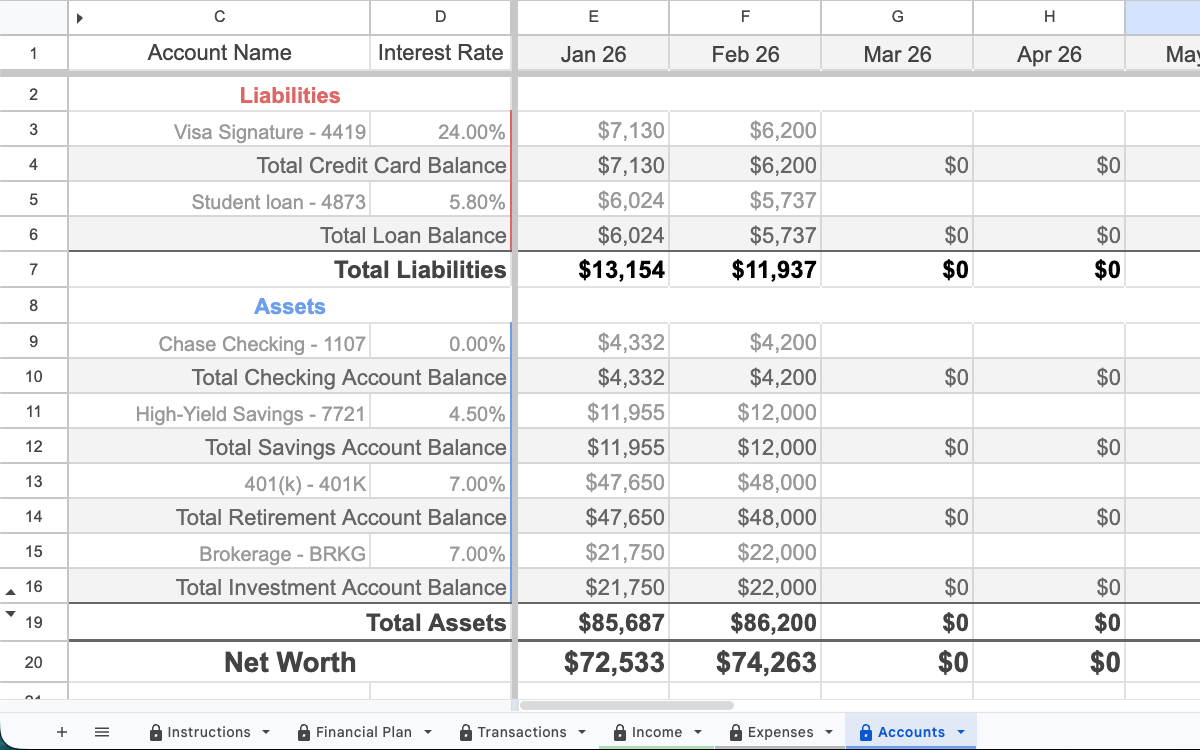
You now have two connected views. The income and expense review shows ongoing cash flow. The Accounts review shows balances, liquidity, debt, and net worth. Keeping both current makes changes in your financial position easier to explain.
AI prompt to explain what actually changed your net worth
“Use my Financial Plan from Financial Assistant and the debt and cash classifications we approved. Bring assets and liabilities to a consistent reporting date and flag stale property values or missing accounts. Reconcile balance changes into contributions, withdrawals, principal repayments, fees, and investment results where records allow. Distinguish accessible cash from retirement or property value. Show my net worth and what drove its change; do not treat contributions as investment returns. Propose dated Accounts updates and unresolved questions for approval.”
6. How does this help you decide what to spend on rent or a car?
Bring the findings into a monthly cash budget. In this example, the person also chooses to reserve $200 per month for future annual bills.
| Monthly cash budget | Amount |
|---|---|
| After-tax income average | $6,735 |
| Needs, including $180 debt interest | $3,400 |
| Wants | $1,100 |
| Required debt principal | $180 |
| Reserve for future annual bills | $200 |
| Remaining for additional priorities | $1,855 |
The $1,855 is the starting amount to allocate among the emergency-fund gap, extra debt repayment, additional retirement contributions, and other goals. Check payroll deductions and existing contributions when adapting the example to your own budget.
How much should I spend on rent?
Compare the full housing cost with the rest of your financial picture. Include utilities, insurance, parking, commuting changes, and moving costs where applicable. Then ask what the housing choice leaves for your other priorities.
Here, increasing total monthly housing costs from $1,900 to $2,300 uses another $400. The $1,855 remainder becomes $1,455. Essential monthly commitments also rise from $3,580 to $3,980, so the chosen four-month emergency target increases to $15,920. A more expensive home changes both the monthly budget and the cash cushion this person wants to maintain.
Can I afford a new car?
Compare the total ownership cost with what transport already costs you. Include the payment, insurance, fuel or charging, registration, maintenance, parking, and any cash needed upfront. Check the financing terms as well as the monthly amount.
If the current $350 transport cost is replaced by a $700 total monthly cost, the increase is $350. The example’s remainder becomes $1,505 before other changes. Making both the housing and car changes would leave $1,105. The next decision is whether those choices fit the goals and financial resilience this person values.
AI prompt to find the true cost of a rent or car upgrade
“Use my Financial Plan from Financial Assistant and our corrected income, spending, debt, and cash figures. Compare my current situation with the rent or car change I am considering, including related costs and upfront cash. Ask for missing terms and use what I have told you I want to protect. Show what remains for other priorities and how essential spending and my emergency-fund gap change. Test a weaker-income month. Propose a separate scenario for approval without overwriting my current budget.”
If the next purchase is a home, carry these numbers into the Home Purchase Playbook guide. It builds on your financial picture to test full ownership costs, upkeep, comparable sales, and mortgage choices.
7. How do you keep your financial picture current?
Check upcoming bills and cash before payday. Each month, reconcile transactions and dated balances, replace forecasts with actuals, and review changes to income or commitments. A transfer, annual bill, and recurring spending increase need different responses. Record the reason before changing a budget.
AI prompt to explain what changed this month
“Use my Financial Plan from Financial Assistant and the previous snapshot we approved. Compare actual income, spending, debt, cash allocations, and net worth on consistent dates. Ask for the prior snapshot if it is unavailable. Explain which differences are timing, one-off events, errors, or recurring changes, and how they affect spendable cash and reserves. Carry forward my latest preferences, ask about changed commitments, and propose reconciled balances and forecast updates for approval. If the change affects a goal, identify which planning decision we need to revisit.”
How does the playbook help you work through this with AI?
Finance OS brings transactions and balances from linked accounts into your Google Sheet. The Personal Finance Playbook provides the template and process for organizing and reviewing your financial picture. You connect your Sheet to your own AI and work through the questions using your numbers. How Finance OS works, Personal Finance Playbook
Some answers come from transactions and balances. Others require your input, including expected income, filing details, loan terms, annual bills, and what you want your money to do. The value of the process is the way each answer guides the next question.
If income is variable, AI can help you examine a lower-income case. If a spending increase comes from an annual bill, the next question is when it returns and how to prepare for it. If a savings balance includes tax money, that changes the emergency-fund calculation. You review the assumptions and approve the updates you want to keep in your Sheet.
Use the Financial Management worksheet guide to review how Income, Expenses, and Accounts fit together.
When are you ready to start financial planning?
You have a useful starting point when you can explain your after-tax income, your regular and irregular spending, the cost and payments of your debts, the purpose of your cash, and the balances of your longer-term assets.
Financial Planning uses that picture to choose priorities and explore the future. You can decide how much to direct toward debt, a home purchase, retirement, or another goal, then compare the trade-offs. The Financial Planning part of the Personal Finance Playbook builds on the information you have assembled.
Use the step-by-step Financial Planning guide to compare where savings should go, fund goals, and test retirement assumptions.
Keep the management picture current as you go. Reconcile new transactions, replace forecasts with actual income, review balances on consistent dates, and revisit the assumptions when your life changes.
Common questions about personal financial management
What is the difference between financial management and financial planning?
Financial management establishes what you earn, spend, own, and owe. Financial planning uses that picture to choose goals, decide where savings go, and review progress. Start with reliable cash flow and net worth so later decisions use money that is actually available.
Can AI tell which subscriptions are worth keeping?
AI can identify recurring charges, overlapping services, price changes, and cancellation terms from available records. Value also depends on how you use a service and what matters to you. Confirm those preferences before accepting a suggestion to switch or cancel.
What should I gather before starting?
Gather pay stubs, income records, recent tax information, bank and card transactions, loan statements, and account balances. Include annual bills and expenses that may fall outside the months you are reviewing. The missing information becomes part of the questions to work through.
How do I budget when income changes each month?
Keep actual income separate from forecasts and identify the cash you can reliably expect. Test whether essential commitments fit a conservative month, then decide how stronger months will support taxes, reserves, debt, and other priorities.
How often should I review my finances?
A monthly review can connect spending, income, and balances. Check cash and upcoming bills more frequently when paydays and due dates are close together. Revisit the full-year forecast after a pay change, a major expense, or a change in expected income.
Get the Personal Finance Playbook
Bring your income, expenses, and accounts together in a financial workspace you can understand and use. Work through the Financial Management process with your AI, then use that picture to make a plan for what comes next.
You receive the matching Google Sheets™ template and guided prompts for Financial Management and Financial Planning. Enter your name and Gmail address and we’ll send you the Personal Finance Playbook.