How to Manage Freelance Finances with AI and Google Sheets™
Understand freelance profit, payment timing, tax reserves, and owner pay using connected AI prompts and the Business Finance Playbook in Google Sheets.
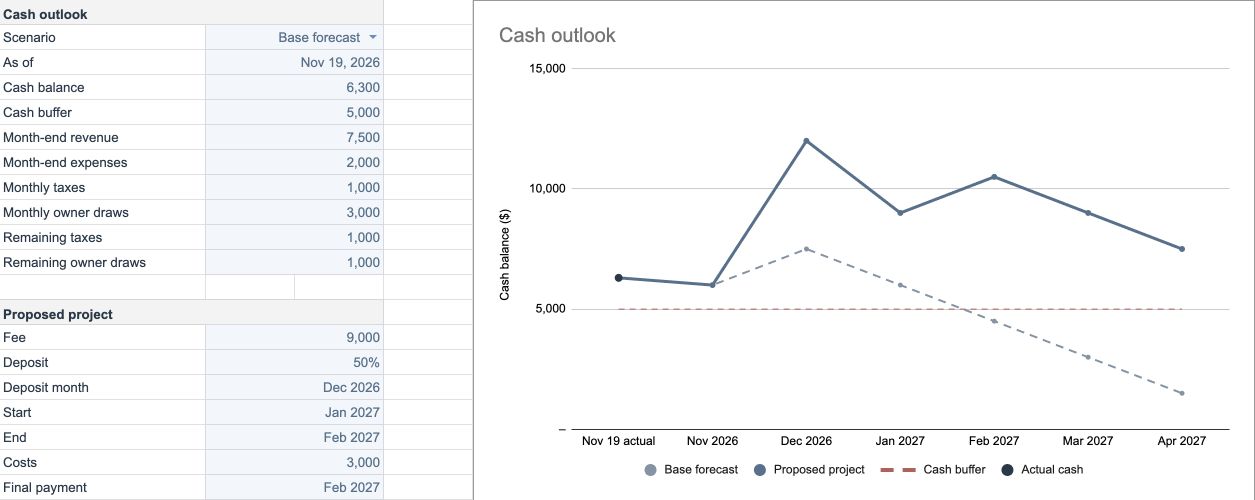
Freelance financial management connects the work you sell with the cash your business can safely use. Review income and costs, separate profit from cash collected, forecast dated commitments, and test what remains for taxes, business resilience, and paying yourself.
Use the Business Finance Playbook and its worksheet guide for Expenses, Profit & Loss, Balance Sheet, and Cash Flow. This guide applies that process to freelancers. Add contract, invoice, and project details where needed; bank transactions alone cannot show work you have not yet been paid for.
These prompts assume your AI can access your Business Finance workspace from Financial Assistant and its transaction and account records. Add missing contract, invoice, or time information when needed. Use relevant preferences already available to your AI, ask about missing or changed context, and approve proposed changes before they are saved to your Sheet.
1. What have you earned, collected, and committed?
Check the period and accounting basis before comparing numbers. Record client work, amounts billed, cash received, paid expenses, and unpaid obligations. Keep owner contributions, withdrawals, transfers, and borrowing distinguishable from operating income and costs.
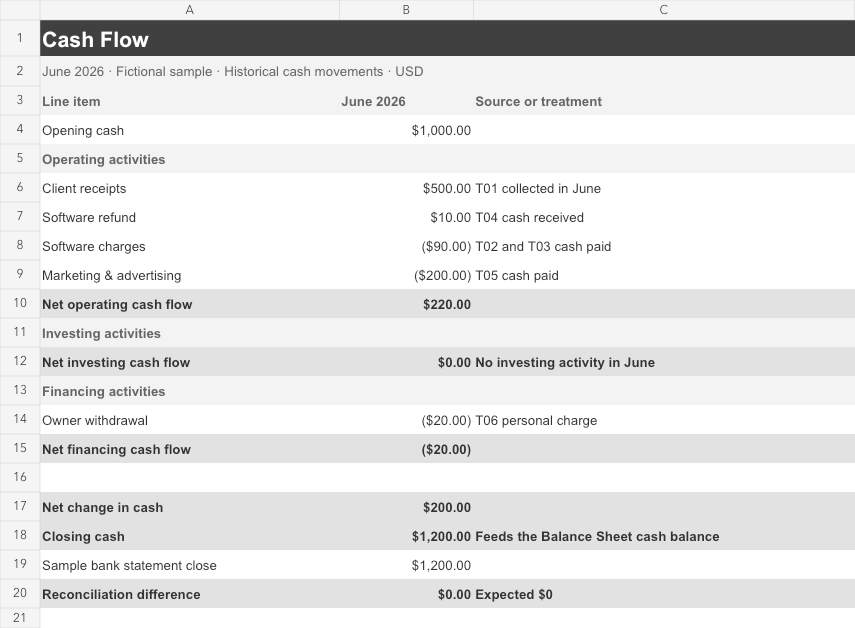
The business worksheet demonstration shows $650 of revenue, $330 of expenses, and $320 of profit before income tax. Its cash flow shows $220 from operations, a $20 owner withdrawal, and $1,200 closing cash from a $1,000 opening balance. Profit, cash generated, and owner pay answer different questions.
AI prompt to explain why freelance profit is not the cash you can pay yourself
“Use my Business Finance workspace from Financial Assistant and the underlying transactions and balances. Reconcile income, expenses, unpaid items, and owner transfers for the same period and accounting basis. Ask for contract or invoice details the bank records cannot show. Explain why reported profit differs from cash movement and flag missing records. Propose classification corrections and a dated baseline for approval.”
2. Could a profitable project make cash tighter?
Put expected collections and project costs on dates, including contractor deposits, software, materials, and ordinary overhead. Keep the confidence of each expected payment visible. An invoice due date is not a cleared deposit.
In a separate fictional freelance forecast, available operating cash starts at $6,000 after existing earmarks. A project will pay $5,000 at the end of month two and costs $1,500 at the start of month one. Ordinary cash costs are $2,000 each month. The project is profitable before other costs, but cash falls to $500 before the collection.
| Event | Cash movement | Running cash |
|---|---|---|
| Starting available operating cash | — | $6,000 |
| Project setup costs | −$1,500 | $4,500 |
| Month one ordinary costs | −$2,000 | $2,500 |
| Month two costs before collection | −$2,000 | $500 |
| Client pays at end of month two | +$5,000 | $5,500 |
AI prompt to find the cash pinch before accepting a project
“Use my Business Finance workspace from Financial Assistant and the baseline we reconciled. Add this project’s verified payment terms and costs to a dated cash forecast. Ask about missing collection timing, deposits, and committed work. Compare the base case with a late client payment, showing the lowest balance before cash arrives. Keep actuals separate from forecasts. Propose the project scenario and cash questions for approval.”
A $2,000 client deposit would raise the low point from $500 to $2,500 if other terms stayed the same; it would also reduce the later collection to $3,000. Total project revenue remains $5,000. Negotiate the terms before treating that alternative as agreed.
3. Which work earns enough for the time it takes?
Compare revenue with direct costs, realistic delivery hours, revisions, and collection work. Keep a project contribution separate from profit after shared overhead and taxes. A high invoice can hide a low return on the hours you actually spend.
For the same project, $5,000 less $1,500 of direct costs leaves $3,500 before shared overhead and tax. At 50 hours that is $70 per hour; at 80 it is $43.75. Scope and revision assumptions can matter more than the headline fee.
AI prompt to find the project that looks better on the invoice than in your week
“Use my Business Finance workspace from Financial Assistant and the project scenarios we established. Compare client revenue, direct costs, expected hours, revisions, and collection effort using the kind of work and flexibility I have said I want. Ask for missing time or scope assumptions. Show project contribution and contribution per hour separately from full business profit. Compare a realistic scope or price change and propose the assumptions I choose for approval.”
4. How much cash is already needed for tax and business commitments?
Project receipts are not all spendable. Forecast business results, identify tax assumptions appropriate to your structure and household, and reconcile estimated payments already made. The IRS self-employed tax center explains why both income and self-employment taxes may matter.
Do not apply a universal reserve percentage as though it were your tax liability. Keep a labelled planning estimate, the income base, payment dates, and what still needs tax-professional confirmation. Maintain a business buffer based on cash volatility and commitments rather than assuming every freelancer needs the same amount.
AI prompt to separate cash you earned from cash you can use
“Use my Business Finance workspace from Financial Assistant and our profit and cash forecast. Identify tax, supplier, project, and operating commitments already attached to the cash balance. Ask for missing structure, tax assumptions, prior estimated payments, and due dates. Keep household taxes and business obligations reconciled without reserving the same tax twice. Show available cash after protected commitments and propose labelled reserves and verification questions for approval.”
5. What can you sustainably pay yourself?
Compare a repeatable owner draw with the cash low point after reserves and committed spending. In a sole-proprietor illustration, withdrawing money does not create another operating expense; keep entity-specific payroll or distribution treatment separate and verify it where relevant.
Carry the amount and timing you choose into your personal financial picture. Test a weaker collection month before using a strong invoice month to support a permanent housing or car commitment.
AI prompt to find owner pay that survives a slow client month
“Use my Business Finance workspace from Financial Assistant, our protected reserves, and the dated cash scenarios we approved. Compare an owner-pay amount I can repeat with a variable amount tied to collections. Ask for my household’s essential cash need if it is unavailable. Show the business low point and household effect under ordinary and delayed collections, using the correct treatment for my structure. Propose the amount and review rule for approval.”
6. How do you keep the business and household plans connected?
Each week, check collections due, upcoming costs, and the lowest forecast cash point. Each month, reconcile the bank records and accounting reports, review project assumptions, and update tax estimates when material facts change.
If a client pays late, distinguish delayed cash from lost revenue. If a project regularly consumes more hours than planned, revisit scope or pricing. Update the household plan after changing owner pay so both plans stop promising the same money.
AI prompt to find the change that matters most before your next draw
“Use my Business Finance workspace from Financial Assistant and the cash and owner-pay plan I approved. Compare actual collections, costs, project hours, and cash with the forecast. Separate timing changes from recurring profitability issues. Ask for missing client updates and identify the next cash low point. Compare a deposit, scope, cost, or draw adjustment that fits how I want to work. Propose the revised forecast and the household update to review for approval.”
Common questions
Is a freelance finance plan the same as a personal budget?
No. The business plan explains earnings, costs, commitments, and cash available for owner pay. The personal budget uses the income you can rely on from that business alongside household spending, debt, and goals. Connect the two without mixing transactions or spending the same cash twice.
Can AI find unpaid invoices from bank transactions?
Bank data can show recorded receipts, but it cannot reliably establish every invoice or payment due. Add the relevant billing and contract records, then reconcile expected collections with actual deposits.
Does this require a separate freelancer product?
This guide applies the Business Finance Playbook to freelance decisions. Use its matching template and process, with your own project and billing details where the financial records need more context.
How the process works with your AI
The Business Finance Playbook provides a Google Sheets™ template, financial tools, and a process to work through with your AI. Finance OS supplies linked transactions and balances; you supply missing project facts, choose scenarios, and approve updates.
Use the business worksheet guide to reconcile the reports. Then connect owner pay to Financial Management and Financial Planning for your household goals.
Get the Business Finance Playbook
Get the matching Google Sheets™ template and guided prompts to work through with your AI. Enter your name and email address and we’ll send you the Business Finance Playbook.